

Acid Gas and Fume Control
How Wet and Dry Scrubbing Systems Remove SO₂, NOx, HCl, Hydrogen Sulfide and Other Industrial Pollutants
Scrubbers are air pollution control devices that use liquid or dry sorbent material to remove pollutants from industrial exhaust streams. They are one of the primary technologies used to control gaseous emissions, particularly acid gases, across a broad range of industrial and municipal applications. Scrubber systems can handle high-temperature and high-humidity gas streams without temperature limits or condensation problems, require relatively little space compared to the volume of exhaust they treat and can absorb gaseous and solid particulate matter simultaneously in a single device.
Wet and dry scrubbing systems achieve up to 99%+ removal of acid gases, alkaline gases and corrosive fumes, handling high-temperature, high-humidity and high-particulate exhaust streams where other abatement technologies cannot operate.
CECO’s industrial air experts match the best scrubbing technology to the specific acid gas, flow rate and process conditions of each application.
WHAT ARE ACID GASES AND WHY MUST THEY BE CONTROLLED?
Understanding Acid Gas Emissions and Regulatory Requirements
Acid gases are gaseous pollutants that form acidic compounds when dissolved in water. The most commonly regulated acid gases in industrial applications are sulfur dioxide (SO₂), hydrogen chloride (HCl), hydrogen fluoride (HF), hydrogen sulfide (H₂S), chlorine (Cl₂) and Nitrogen oxides (NOx). These are also included in a regulated gas class that intersects with scrubbing system design in multi-pollutant treatment scenarios.
Sulfur dioxide (SO₂)
Sulfur dioxide (SO₂) is generated by the combustion of sulfur-containing fuels and by certain chemical and smelting processes. In the atmosphere, SO₂ reacts with moisture to form sulfuric acid, which contributes to acid rain and respiratory health impacts. SO₂ is regulated under the Clean Air Act as a criteria air pollutant and is subject to New Source Performance Standards (NSPS) for major source categories.
Hydrogen chloride (HCl)
Hydrogen chloride (HCl) is generated by the incineration of chlorinated materials, the combustion of chlorinated VOCs in thermal oxidizers, chemical manufacturing processes and semiconductor fabrication. When halogenated VOCs are destroyed in a thermal oxidizer the combustion products include HCl and HF which must be scrubbed downstream of the oxidizer.
Nitrogen oxides (NOx)
Nitrogen oxides (NOx) are generated during high-temperature combustion in thermal oxidizers. NOx control in scrubbing systems is more complex than for acid gases because nitrogen oxides are less soluble in water than SO₂ or HCl. Achieving high NOx removal efficiency in a wet scrubber requires specific reagent chemistry including oxidizing solutions such as hydrogen peroxide that convert NOx to more water-soluble forms. For many applications selective catalytic reduction (SCR) and selective non-catalytic reduction (SNCR) systems are used in combination with wet scrubbers to address the full pollutant spectrum — the scrubber handling acid gases and particulate while the SCR or SNCR system handles NOx.
Hydrogen sulfide (H₂S)
Hydrogen sulfide (H₂S) is generated in kraft pulping, petroleum refining, wastewater treatment, rendering and food processing operations. It is both a toxic gas and a potent odor compound detectable at parts-per-billion concentrations. Regulatory limits for H₂S vary by regions with facilities near residential communities subject to nuisance odor regulations that may require near-complete removal.


Wet Versus Dry Scrubbers
Choosing Between Wet and Dry Scrubbing Systems
When wet scrubbing is the right choice:
Wet scrubbers are the appropriate selection when high removal efficiency (95–99%+) for soluble acid gases is required, when the process stream contains both gaseous pollutants and particulate matter that must be addressed simultaneously, when the facility has water handling infrastructure and when the process gas is at elevated temperature or humidity that would be difficult to handle with dry systems.
When dry scrubbing is the right choice:
Dry scrubbers are appropriate when water handling infrastructure is not available, when moderate removal efficiency is acceptable, when simultaneous control of acid gases and dioxins or furans is required with activated carbon injection and when operating in cold climates where wet scrubber freeze protection is a concern.
| Criteria | Mist Eliminator | Fiber Bed Mist Eliminator | Venturi Scrubber | MicroMist Scrubber | WESP |
|---|---|---|---|---|---|
| Submicron collection | Low to moderate (primary collection of larger droplet) | 99.9%+ via Brownian diffusion | Moderate – above 1 micron | High – 99.9%+ | 99.9%+ via electrostatic |
| *Pressure drop | Low | Moderate | High | Low | Low |
| Liquid loading | Moderate – intermittent or lower liquid volume streams | Heavy liquid capable-continuous high liquid drainage without re-entrainment | High liquid loading | Low to moderate – low liquid waste generation | High liquid handling |
| Space requirement | Low – minimal footprint | Moderate – standard vessel sizing | Compact – smaller footprint suitable for retrofits | Compact – smaller footprint suitable for retrofits | Compact – smaller footprint suitable for retrofits |
| Best application | Scrubber outlet droplet separation | Acid mist, oil mist, CPM | CPM and particulate combined | Submicron CPM and trace metals | Submicron aerosol, sticky mist |
*specific pressure drop and efficiency values vary by application and system design

Packed Bed Wet Scrubbers
A packed bed scrubber, also called a packed tower or absorber, uses a vertical column filled with structured or random packing material such as plastic or metal rings to provide a large wetted surface area for contact between the gas stream and the scrubbing liquid. As contaminated gas moves upward through the packed bed scrubbing, liquid trickles downward over the packing surface in a countercurrent flow arrangement. This creates extensive gas-liquid contact, enabling absorption of gaseous pollutants through mass transfer from the gas phase to the liquid phase.

Venturi Scrubbers
A venturi scrubber uses a constricted throat section to accelerate the gas stream to high velocity, creating intense turbulence and maximizing contact between the pollutant-laden gas and scrubbing liquid. Scrubbing liquid is injected directly into the high-velocity throat region where the speed causes the liquid to break into fine droplets ensuring intense mixing. Venturi scrubbers are more effective at removing particulate matter than gaseous pollutants though they handle both simultaneously.

Multi-Stage Wet Scrubbers for NOx Control
Standard packed bed and venturi scrubbers are not effective as standalone solutions for NOx removal. This is because NOx compounds, primarily NO and NO₂ , have low water solubility compared to acid gases. Standard wet scrubber designs optimized for acid gas removal achieve limited NOx capture without reagent enhancement.
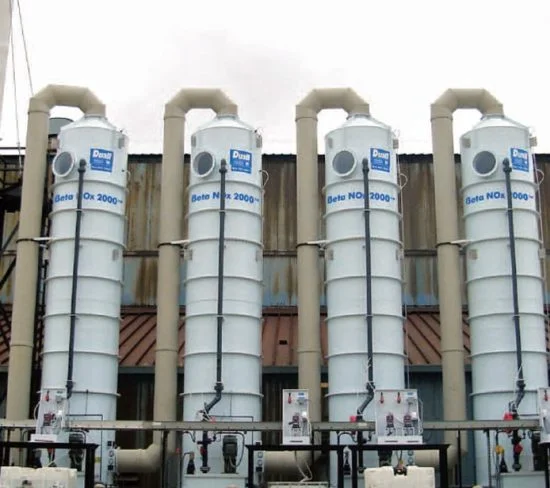
Single and multiple stage systems can provide more than 99% efficiency for total NOx removal and elimination of the characteristic red-brown NOx exhaust plume visible from stacks at facilities with uncontrolled NOx emissions. These systems use minimal maintenance thermoplastic construction for complete corrosion resistance.
For most industrial applications requiring both acid gas and NOx control, the most effective approach combines a wet scrubber for acid gas and particulate removal with a separate SCR or SNCR system for NOx reduction. This hybrid approach leverages the strengths of each technology. The scrubber handles the acid gas and particulate fraction while the SCR or SNCR system addresses the NOx through a different chemical mechanism that is inherently more effective for nitrogen oxide reduction.

Tray Scrubbers
Tray scrubbers use a series of horizontal perforated plates or trays rather than packing material to create gas-liquid contact. Gas flows upward through the perforations of each tray while liquid flows across the tray surface and over a weir to the tray below, creating a bubbling action as the gas passes through the liquid layer on each tray. This configuration maximizes removal of volatile water-soluble compounds, including alcohols and ketones, while minimizing water usage when compared to spray or packed systems.

Ionizing Wet Scrubbers
Ionizing wet scrubbers combine the mechanisms of a wet electrostatic precipitator and a packed bed scrubber in a single compact unit. The ionizing section charges particulate matter and submicron aerosols electrostatically before they enter the packed scrubbing section, where both the charged particles and contaminant gases are removed simultaneously. This combined approach addresses the limitation of conventional packed bed scrubbers, which have limited efficiency for fine particulate, and adds gaseous absorption capability to an electrostatic collection mechanism.
Aerators and Degasifiers
Aerators and degasifiers strip dissolved gases from process water and wastewater rather than removing gases from air streams. They use air-to-water contact to transfer dissolved VOCs, H₂S, CO₂ and ammonia from the liquid phase to a concentrated air stream that can then be directed to a thermal oxidizer or other abatement device for treatment. This technology is used where dissolved gas contamination in process water or wastewater creates both a treatment compliance requirement and an odor or safety concern.
Dry Scrubbing Systems
Dry scrubbers remove pollutants from exhaust gases without using a liquid medium. Instead they use dry sorbent materials, alkaline reagents such as sodium bicarbonate, calcium hydroxide (hydrated lime) or trona that are injected into the exhaust gas stream or into a reaction vessel. The sorbent reacts with acid gases to form solid reaction products that are captured by a downstream fabric filter or baghouse.
Dry scrubbers are primarily implemented for removal of acid gases including SO₂, HCl, HF and in some configurations heavy metals, dioxins and furans from combustion exhaust. They are particularly well suited for facilities that lack the infrastructure to properly handle produced wastewater, which is the primary output of wet scrubbing systems.
Many industrial applications generate exhaust streams containing multiple pollutants simultaneously, such as particulate matter, acid gases, NOx, heavy metals and trace organics, that no single scrubber technology can address comprehensively on its own. Staged treatment systems combining multiple technologies in a series are the standard approach for these applications.
A common staged treatment sequence for waste incineration or chemical process exhaust includes:
stage 1 – Particulate pre-removal
A cyclone or baghouse removes bulk particulate before the gas enters the scrubbing system, reducing the particulate load that the scrubber must handle and protecting scrubber internals from abrasion and fouling.
stage 2 – Acid gas scrubbing
A packed bed wet scrubber or dry scrubber removes HCl, SO₂, HF and other acid gases. For wet systems reagent chemistry is selected based on the specific acid gas profile. For dry systems alkaline sorbent injection is followed by fabric filter capture.
STAGE 3 –NOx CONTROL
When NOx removal is required an SCR or SNCR system addresses nitrogen oxides through a different chemical mechanism than the acid gas scrubber. Wet scrubbers are not effective as standalone NOx controls but they contribute to a more stable combustion environment that reduces NOx formation upstream.
Stage 4 – Mist elimination
A mist eliminator removes entrained liquid droplets from the outlet gas stream before stack discharge, ensuring no visible steam plume and preventing liquid carryover that could cause downstream corrosion.
The specific sequence and combination of technologies depends on the pollutant profile, flow volume, regulatory limits and site constraints of each application.

CECO Environmental designs and manufactures wet and dry scrubbing systems for industrial and municipal acid gas and fume control applications. CECO’s scrubbers are engineered for the specific process conditions and regulatory requirements of each application. CECO provides turnkey project delivery including design, fabrication, installation, commissioning and ongoing maintenance support.


More Than Equipment. Engineered for Industrial Air Excellence.
As the world’s most complete end-to-end industrial air quality platform, CECO Environmental spans every stage of the industrial air treatment process, from the point of generation through final compliance. We listen and solve, innovate and support, across every major global market, so nothing stands in the way of your operations.
