

Industrial Odor Control
How Thermal Destruction and Non-Thermal Abatement Systems Eliminate Process Odors and Protect Facility Operations and Communities
Odor emissions from industrial processes arise from two fundamentally different source types: thermally generated organic emissions from combustion, heating, chemical reaction and solvent evaporation, and biologically generated emissions from wastewater treatment, anaerobic digestion, fermentation, composting and organic material handling. Each source type presents a distinct contaminant profile, air volume and concentration range that determines which abatement technology is appropriate.
Selecting the right technology requires understanding the odor source, inlet concentration, air volume and the regulatory and community obligations of the facility.
Thermal oxidation is the correct approach for concentrated process exhaust streams where VOCs, HAPs and odor compounds are present at combustible concentrations. The same oxidation mechanism that destroys VOCs also eliminates the organic sulfur compounds, nitrogen-containing organics and other trace odor-causing compounds.
Biological and chemical non-thermal abatement is the correct approach for high-volume, low-concentration odor streams where the air volume is too large and the contaminant concentration too low for thermal treatment to be economical, and for biogenic sources such as wastewater treatment where hydrogen sulfide and reduced sulfur compounds require treatment without combustion.

Why Industrial Facilities Must Control Odor Emissions
Community Protection and Odor Nuisance Prevention
Industrial odor emissions create regulatory, community, worker safety and permit obligations. Odor compounds including hydrogen sulfide, mercaptans, reduced sulfur gases and organic VOCs are detectable by the human senses at concentrations far below their regulatory permit thresholds. A facility can be in full VOC and HAP regulatory compliance and still be generating community odor complaints that trigger permit review, enforcement and community relations consequences.
Worker Safety and Occupational Health
Hydrogen sulfide and reduced sulfur compounds generated in wastewater treatment and biological processes are acutely hazardous at elevated concentrations and create serious worker exposure risks at concentrations well below immediately dangerous levels. Facilities with wastewater treatment operations on site have both an air quality permit obligation and an occupational health obligation to control these emissions.
Regulatory Compliance and Permit Obligations
Many, regulate odor as a separate permit condition from VOC and HAP limits, requiring facilities to demonstrate control of odorous emissions independent of their compliance status for other air pollutants. Commercial bakeries, for example, release VOC-laden odors into the atmosphere that can negatively impact surrounding communities and trigger regulatory obligations under regional air quality management districts even when total VOC mass emissions are within permit limits.
Net Zero and Greenhouse Gas Reduction Commitments
For facilities with Net Zero or greenhouse gas reduction commitments, non-thermal biological abatement technologies provide odor and H2S control without fuel combustion, reducing the direct emissions associated with thermal treatment and supporting carbon reduction targets.
Industrial Odor Control Technology Comparison
| Technology | Destruction or Removal Mechanism | Confirmed Performance | Process Phase |
|---|---|---|---|
| Regenerative Thermal Oxidizer | Thermal oxidation at 1,500°F — combustion into CO2 and water | 99% DRE; up to 97% primary heat recovery | Vapor phase |
| Catalytic Oxidizer | Catalytic oxidation at 550–800°F using catalyst | High DRE at lower temperature; reduced fuel vs RTO | Vapor phase |
| VOC Concentrator + Oxidizer | Concentrates dilute stream before thermal oxidizer destruction | Up to 99%+ VOC destruction after concentration stage | Vapor phase |
| Biofiltration System | Bio-oxidation — microorganisms digest VOCs and H2S in biofilm | No combustion; reduces NOx and CO2 vs thermal | Vapor phase |
| Bioscrubber | Biological scrubbing in vessels with inert bio bed media | No combustion; biological treatment in scrubbing vessel | Vapor phase |
| Chemical Scrubber | Liquid-phase absorption removes H2S, ammonia and mercaptans | Removes H2S, ammonia and mercaptans via liquid-phase absorption | Vapor phase |
| Activated Carbon Adsorber | Physical adsorption bonds odor compounds to carbon surface | Removes VOCs, HAPs and odors to part-per-billion level | Vapor phase |
| Aerator / Degasifier | Mechanical aeration strips dissolved volatiles into vapor phase | 5 gpm to 5,000 gpm; NSF-61 certified construction available | Liquid phase — upstream of vapor-phase treatment |
Technologies for Industrial Odor Control

Regenerative Thermal Oxidizers (RTOs)
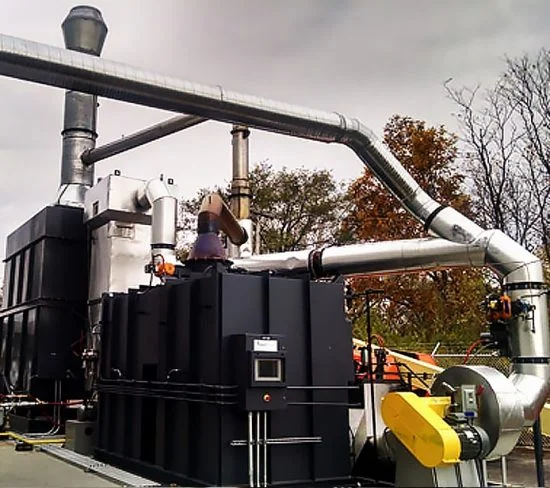
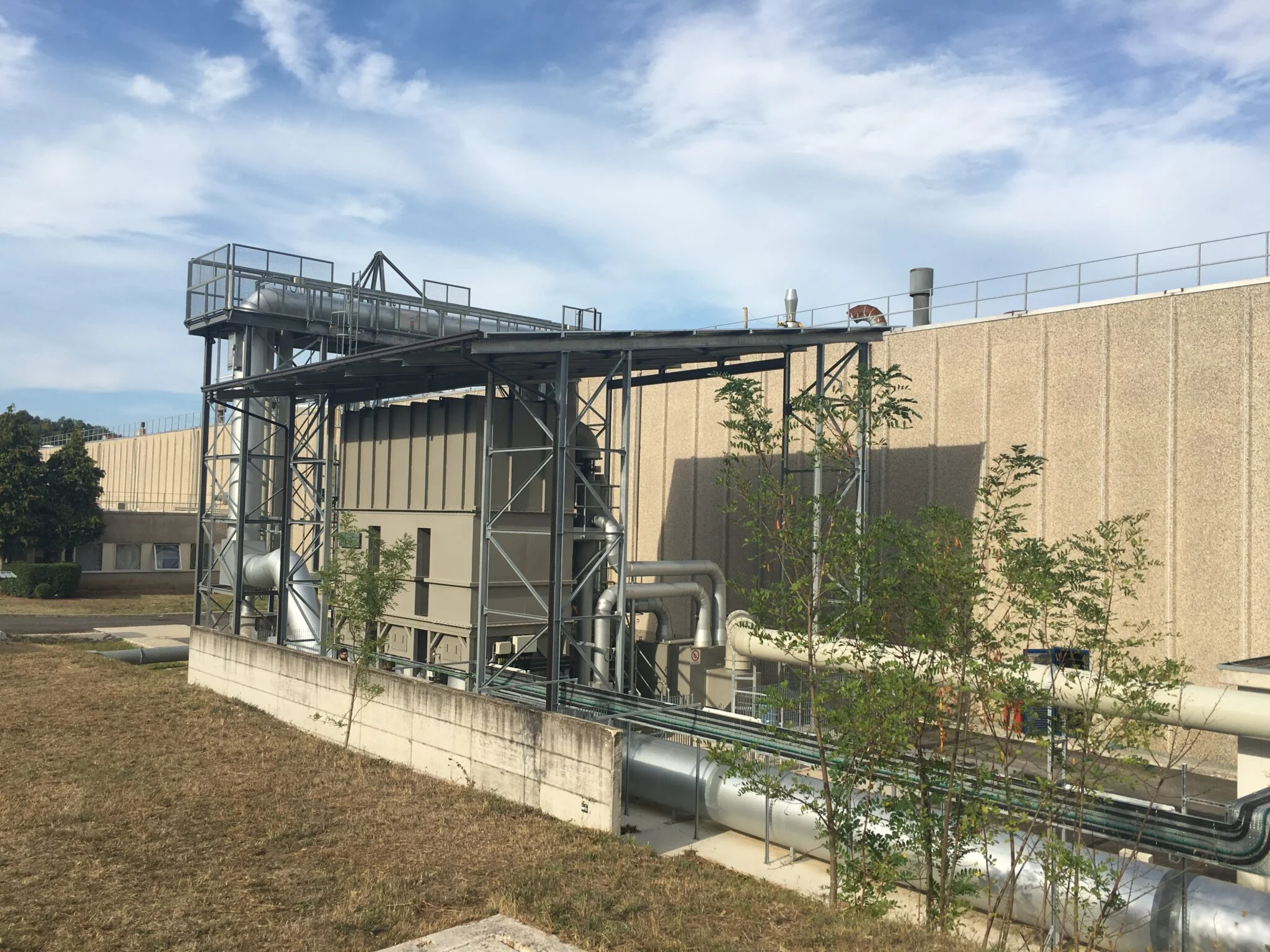
Regenerative thermal oxidizers eliminate VOCs, odors and HAPs from industrial process exhaust through thermal oxidation at high destruction and removal efficiency. RTOs achieve 99% DRE and recover over 95% of thermal energy through ceramic heat exchangers, making them the appropriate technology for concentrated process exhaust streams where odor and VOC control are required simultaneously. The ceramic media beds preheat incoming process air close to the required oxidation temperature before it reaches the combustion chamber, requiring minimal auxiliary fuel input and producing very high rates of heat transfer. Applications include baking and food processing exhaust, chemical manufacturing, flexible packaging and printing operations where process exhaust contains both regulated VOC concentrations and odorous organic compounds.
Catalytic Oxidizers
Catalytic oxidizers enable lower-temperature combustion of VOCs and odor compounds using catalysts that reduce the energy required for oxidation compared to thermal alternatives. Both thermal and catalytic oxidizers achieve high destruction removal efficiency by transforming volatile organic compounds into less harmful substances through oxidation. Catalytic oxidizers are suited for process exhaust streams where odor and VOC concentrations are sufficient for catalytic treatment and where reduced operating temperature and fuel consumption are a priority.

VOC Concentrators
VOC concentrators are used for high-volume, low-solvent-concentration exhaust streams where the air volume is too large for direct thermal treatment but the total VOC and odor load warrants oxidation. The concentrator reduces the solvent-laden airflow to a smaller, more concentrated stream before it enters the thermal oxidizer, increasing oxidation efficiency and reducing operational costs. This is the appropriate technology when odor and VOC control are both required and the exhaust volume makes direct oxidation economically impractical.

Biofiltration Systems
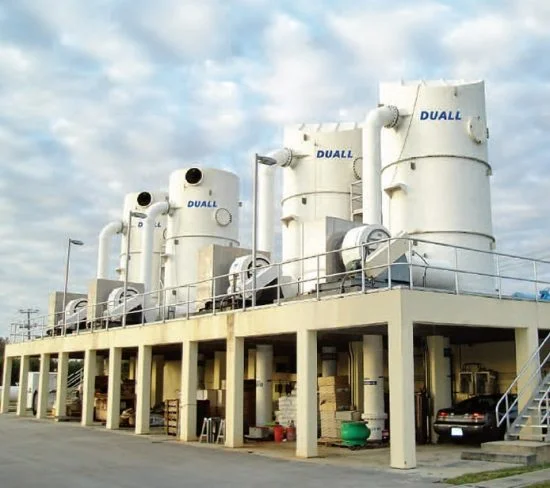
Biofiltration is one of the most environmentally compatible technologies available for controlling odorous and biogenic gas emissions from industrial and municipal processes. Contaminants are transferred into a biofilm, a combination of different microorganisms designed to degrade target compounds, where bio-oxidation occurs and VOCs, hydrogen sulfide and odor compounds are digested by the microbial population in the filter, resulting in clean emissions at the outlet. Biofiltration systems reduce NOx and CO2 emissions compared to thermal alternatives, eliminate fuel combustion and optimize water flow rates and air flow differential pressure to minimize energy requirements.
Bioscrubbers
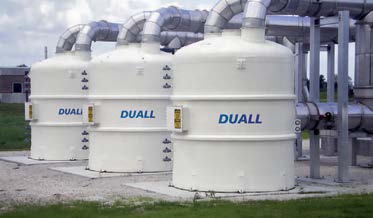
Biological air pollution control scrubbing systems provide a biological treatment pathway for odorous and VOC-containing exhaust streams where vessel-based biological treatment is required. Bioscrubbing systems consist of a pre-humidifier, bioscrubber vessels, inert bio bed media, nutrient feed, liquid recycle pump, duct, control panel and exhaust fan. They are used as a standalone odor control technology and as a downstream exhaust air purification option following aerator and degasifier liquid-phase stripping where vapor-phase biological treatment of the stripped exhaust is required. Wet scrubbers including bioscrubbers use a variety of scrubbing agents and solutions to remove and neutralize pollutants, gases and odors from exhaust streams.
Chemical Scrubbers
Chemical scrubbers provide odor and H2S control for process exhaust streams where biological treatment alone is insufficient or where high inlet concentrations of reactive gas require rapid chemical neutralization. Packed bed chemical scrubbers achieve high-efficiency removal of ammonia, hydrogen sulfide, mercaptans and methyl sulfides using liquid-phase absorption. They are suited to applications with high and variable H2S concentrations where rapid chemical neutralization is required, and as an exhaust air purification option downstream of aerators and degasifiers for industrial wastewater and process effluent systems. Wet scrubbers are one of the primary devices for controlling gaseous emissions and are effective in applications where pollutants are water soluble and amenable to liquid-phase treatment.

Activated Carbon Adsorbers
Activated carbon adsorbers remove VOCs, HAPs and odors from industrial exhaust streams down to part per billion concentration levels. They are used for trace contaminant polishing where inlet concentrations are low but outlet permit requirements are stringent, and as a downstream polishing stage following biological or chemical treatment where residual odor and VOC concentrations must be reduced to the lowest achievable levels. Carbon adsorbers are also used as an exhaust air purification option downstream of aerators and degasifiers where residual odor polishing is required after liquid-phase stripping.
Aerators and Degasifiers
Aerators and degasifiers are liquid-phase stripping systems that remove volatile odor compounds, including VOCs, hydrogen sulfide, CO2, MTBE and ammonia from process water, industrial wastewater and groundwater before those compounds are released to the vapor phase. They are the entry point of the odor control system for facilities where odor compounds are present in dissolved form in process liquids. Removing dissolved H2S and VOCs from the liquid stream before they off-gas reduces the total vapor-phase odor load that downstream biofiltration, bioscrubbing or chemical scrubbing systems must treat. Single column configurations handle capacities from 5 gpm to 5,000 gpm with NSF-61 certified construction available, and exhaust air from aerator systems is directed to downstream bioscrubbers, activated carbon adsorbers or chemical scrubbers depending on contaminant profile and permit requirements.

CECO Environmental provides complete odor control solutions across the full thermal and non-thermal technology spectrum. Comprehensive preventive maintenance packages, media replacement services and engineering consultancy support the full lifecycle of the equipment.


More Than Equipment. Engineered for Industrial Air Excellence.
As the world’s most complete end-to-end industrial air quality platform, CECO Environmental spans every stage of the industrial air treatment process, from the point of generation through final compliance. We listen and solve, innovate and support, across every major global market, so nothing stands in the way of your operations.
