

Industrial Exhaust Management
How Corrosion-Resistant Fans Move and Control Contaminated Process Air
Industrial exhaust management is the movement and control of contaminated process air from the point of generation through the air pollution control system to final discharge. Every industrial air pollution control system, thermal oxidizer, scrubber, dust collector or mist eliminator depends on a fan or blower to move the exhaust stream through the treatment process. A fan that underperforms, corrodes prematurely or fails unexpectedly does not just create a maintenance cost, the fan stops the entire downstream treatment system and can render the facility out of compliance.
Selecting the wrong fan material for the chemical environment of the process stream leads to premature failure, often within months of installation, and replacement costs that far exceed the capital savings of specifying a lower-cost unit.
Fiberglass reinforced plastic (FRP) fans provide better corrosion resistance than metal fans and are less expensive than most exotic alloy alternatives. When paired with the correct resin system and surface finish for the specific chemical environment, FRP fans deliver long service lives in the most aggressive process exhaust applications.

Why Industrial Exhaust Fan Selection Is a Critical Engineering Decision
Corrosion Resistance
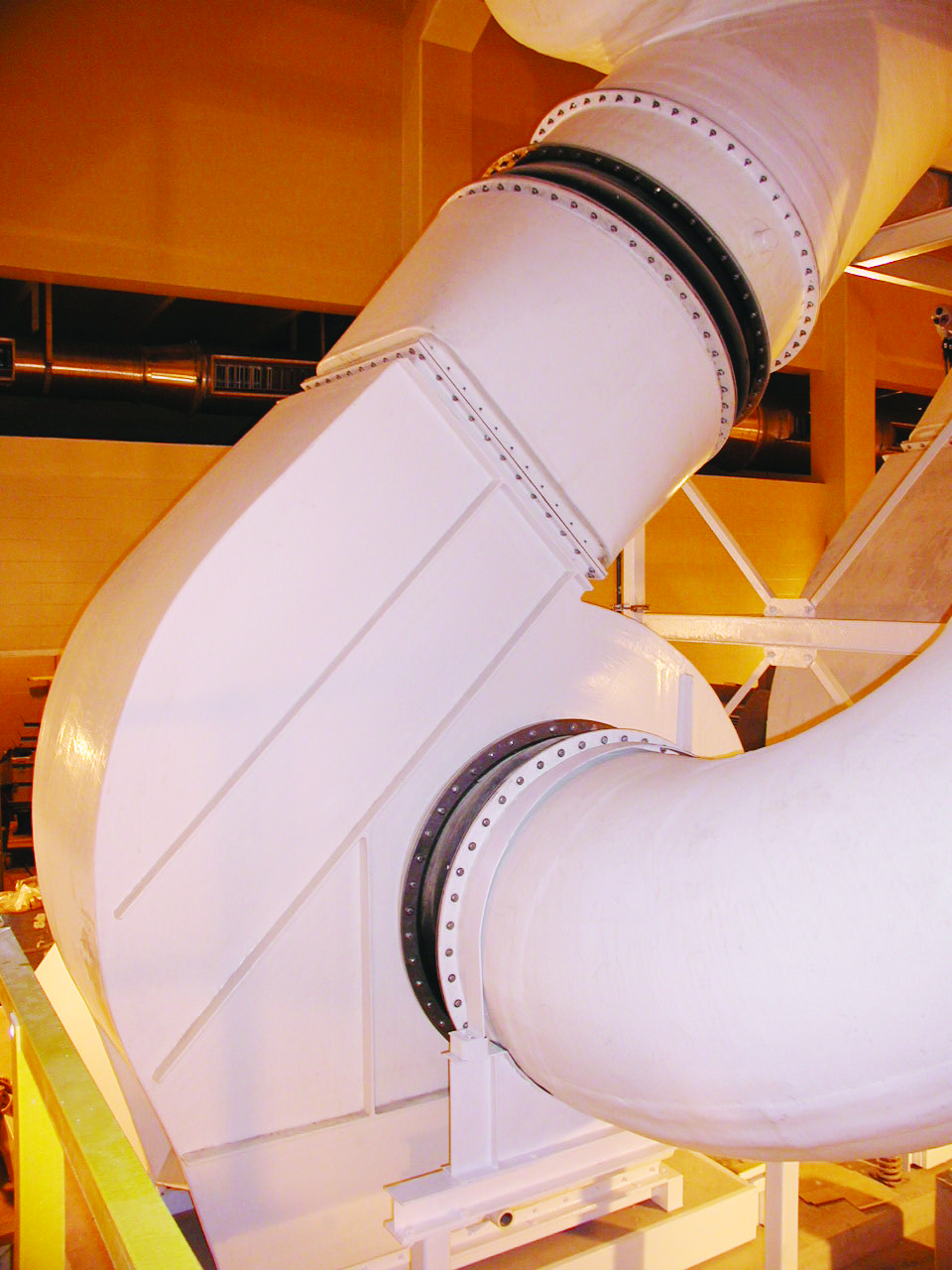
Industrial process exhaust streams contain acid gases, corrosive vapors, moisture and particulates that attack conventional metal fans. Steel fans in chlorine, hydrogen sulfide, hydrofluoric acid or acid scrubber exhaust service corrode rapidly regardless of protective coating. FRP fans with fully encapsulated internal metal components and resin-rich surface layers prevent corrosion from initiating at exposed glass fibers or metal contact points, the primary failure modes of conventional corrosion-resistant designs.
Material Selection for the Specific Chemical Environment
Not all FRP fans are equivalent. The resin system, vinyl ester, isophthalic polyester, epoxy or specialty formulations must be matched to the specific chemicals present in the exhaust stream, their concentrations and the operating temperature. Internal metal components including shaft and fasteners must be fully encapsulated in FRP to prevent contact with the gas stream. Fan flanges must conform to established FRP construction standards. Selecting the wrong resin for the application produces a fan that fails as rapidly as a painted steel unit.
Airflow and Static Pressure Matching
Fan performance is defined by its characteristic curve, the relationship between airflow volume and static pressure across the operating range. The fan must be selected so that its operating point at system resistance intersects the characteristic curve at the desired flow rate. Fans selected too far to either side of the peak efficiency point operate inefficiently, consume excess energy and may experience vibration and mechanical stress that shortens service life.
Reliability and Total Cost of Ownership
An industrial fan that requires frequent bearing replacements, impeller repairs or corrosion-related rebuilds generates maintenance costs and unplanned downtime that far exceed the initial purchase price. Fan total cost of ownership includes initial capital, energy consumption across the service life, maintenance labor and parts and the cost of unplanned downtime when the fan fails. Systems designed for long service life with premium materials, sealed bearing assemblies and accessible maintenance points reduce total cost of ownership significantly compared to lower-cost alternatives.
AMCA Certification
Fan performance ratings for air movement equipment should be verified against AMCA International certified test standards. AMCA certification provides assurance that published performance data reflects actual tested performance rather than calculated estimates, an important distinction when sizing a fan for a compliance-critical air pollution control application.


Selecting the Right Industrial Exhaust Fan
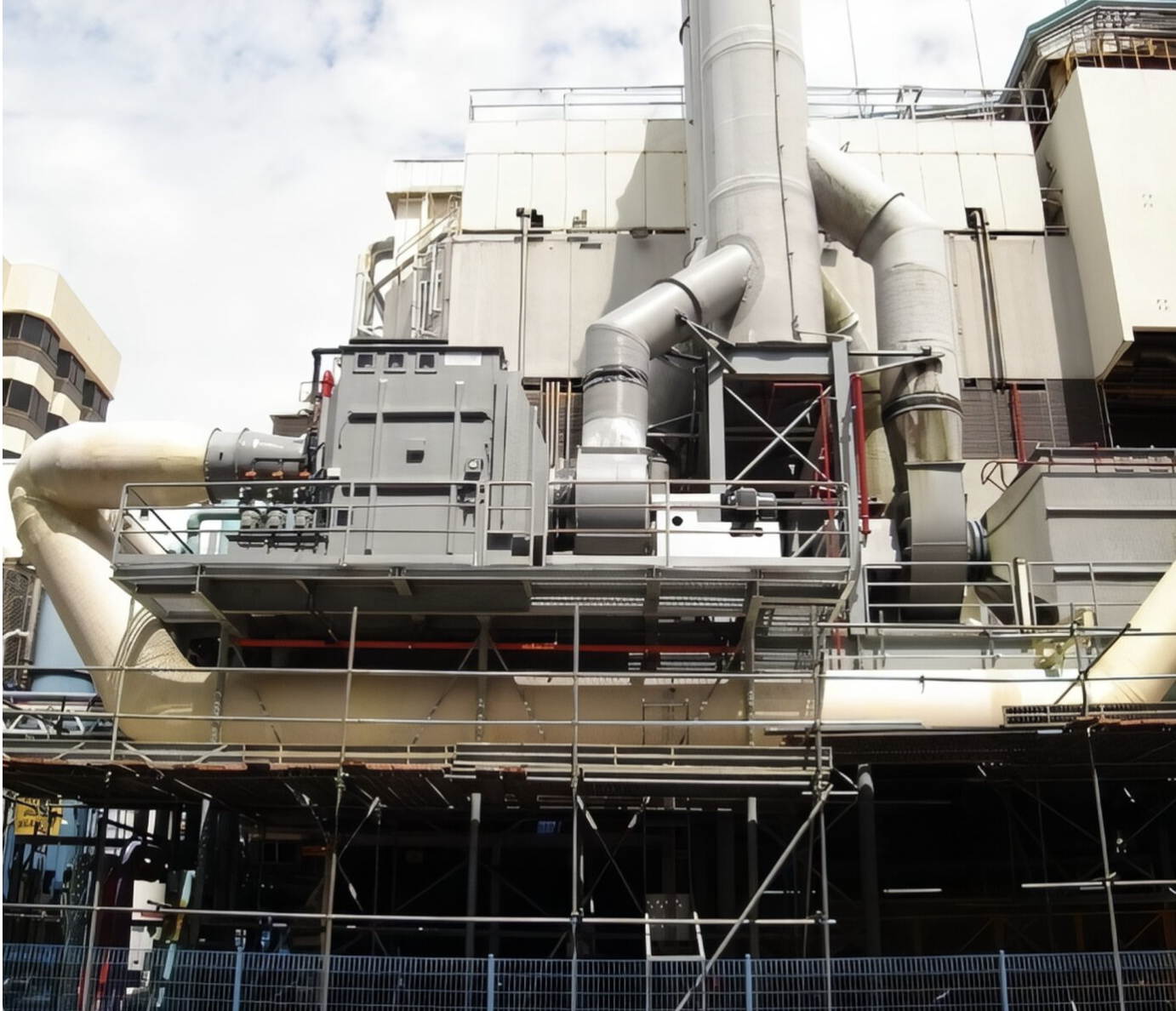
The fan is the engine of every industrial air pollution control system. It establishes the negative pressure that draws contaminated exhaust from process equipment and drives it through ductwork, abatement equipment and final discharge. Every component in the system, capture hood, ductwork, scrubber, oxidizer, dust collector and stack is sized based on the airflow and static pressure the fan generates. Engineering errors in fan selection propagate through the entire system design.
*Specific performance values vary by fan series, size, speed and application conditions
| Technology | Flow Range | Static Pressure | Best Gas Stream | Installation Profile | Key Advantage |
|---|---|---|---|---|---|
| Centrifugal FRP | Up to 150,000 CF | Moderate to high — up to 40 inches WC | Corrosive, moist, chemically aggressive | Standard scroll housing, flexible discharge | Broadest application range; AMCA certified; high static pressure |
| Inline Centrifugal | Moderate volume | Moderate | Corrosive, low-particulate | Inline with duct — no housing elbow required | Reduced ductwork fittings; compact installation |
| Tubeaxial / Vaneaxial | Up to 80,000 CFM | Low to medium — up to 4 inches | High-volume low-resistance corrosive exhaust | Cylindrical housing, inline with duct | Highest volume per horsepower at low static pressure |
| Radial | Low to moderate | High | Particulate-laden or sticky exhaust | Standard scroll housing | Tolerates fouling from particulate and condensate |
| Carbon Fiber | Moderate to high | High — exceeds FRP capability | High-speed corrosive requiring alloy alternative | Centrifugal housing configuration | Higher RPM and pressure than FRP; lighter than alloy |
Industrial Exhaust Fan Technologies for Corrosive Process Air Applications
Centrifugal FRP Exhaust Fans
Centrifugal fans use a rotating impeller to impart velocity to the gas stream and convert that velocity to static pressure through the fan housing. They are the most widely used fan type in industrial air pollution control applications because they generate moderate to high static pressures across a wide range of airflow volumes and handle process conditions including moisture, corrosive gases and entrained particulate that would damage axial fan designs.
How FRP Exhaust Systems Work:
Process air enters the fan through an inlet cone and contacts the rotating impeller. The impeller imparts kinetic energy to the gas stream accelerating it outward by centrifugal force through the blades. The gas exits the impeller at high velocity into the fan scroll housing where velocity is converted to static pressure as the gas decelerates in the expanding scroll geometry. The pressurized gas exits through the fan outlet into the downstream ductwork or abatement equipment.


Inline Centrifugal Exhaust Fans
Inline centrifugal fans are designed for installation directly within the ductwork of an exhaust system. The fan inlet and outlet are collinear with the duct rather than perpendicular as in standard centrifugal fan configurations. This inline arrangement eliminates the elbow or transition required to connect a standard centrifugal fan to a straight duct run, reducing the number of duct components and the associated pressure drop and installation complexity.
Tubeaxial and Vaneaxial Exhaust Fans
Axial fans move air parallel to the fan shaft axis rather than radially as in centrifugal designs. They are designed for applications requiring large volumes of air movement at low to medium static pressures, delivering high airflow at lower energy consumption than centrifugal fans for applications where the system resistance is low.
- Tubeaxial fans use a propeller-type wheel in a cylindrical housing.
- Vaneaxial fans add stationary guide vanes downstream of the rotating wheel to recover rotational kinetic energy from the exiting airstream, increasing static pressure efficiency over the tubeaxial design.
Radial Exhaust Fans
Radial fans use a radial blade impeller, blades that extend straight outward from the hub without forward or backward curvature, to move low to medium quantities of air at high static pressures. The radial blade geometry is more tolerant of particulate-laden and sticky exhaust streams than airfoil or backward-curved blade designs because material buildup on radial blades has less effect on aerodynamic performance. This makes radial fans the appropriate selection for exhaust streams carrying particulate, condensate or material that would degrade the performance of more aerodynamically refined impeller designs.
Carbon Fiber Fans
Carbon fiber fans use carbon fiber composite impellers in place of FRP as the primary construction material. Carbon fiber composites are five times lighter than steel yet ten times stronger. These properties allow carbon fiber fan impellers to reach higher RPM than even the most advanced fiberglass fans, generating higher static pressures and using power more efficiently. The reduced impeller weight puts less stress on the motor, bearings and mechanical components, extending operating life and reducing maintenance requirements.

Custom Fans, Housings and Accessories
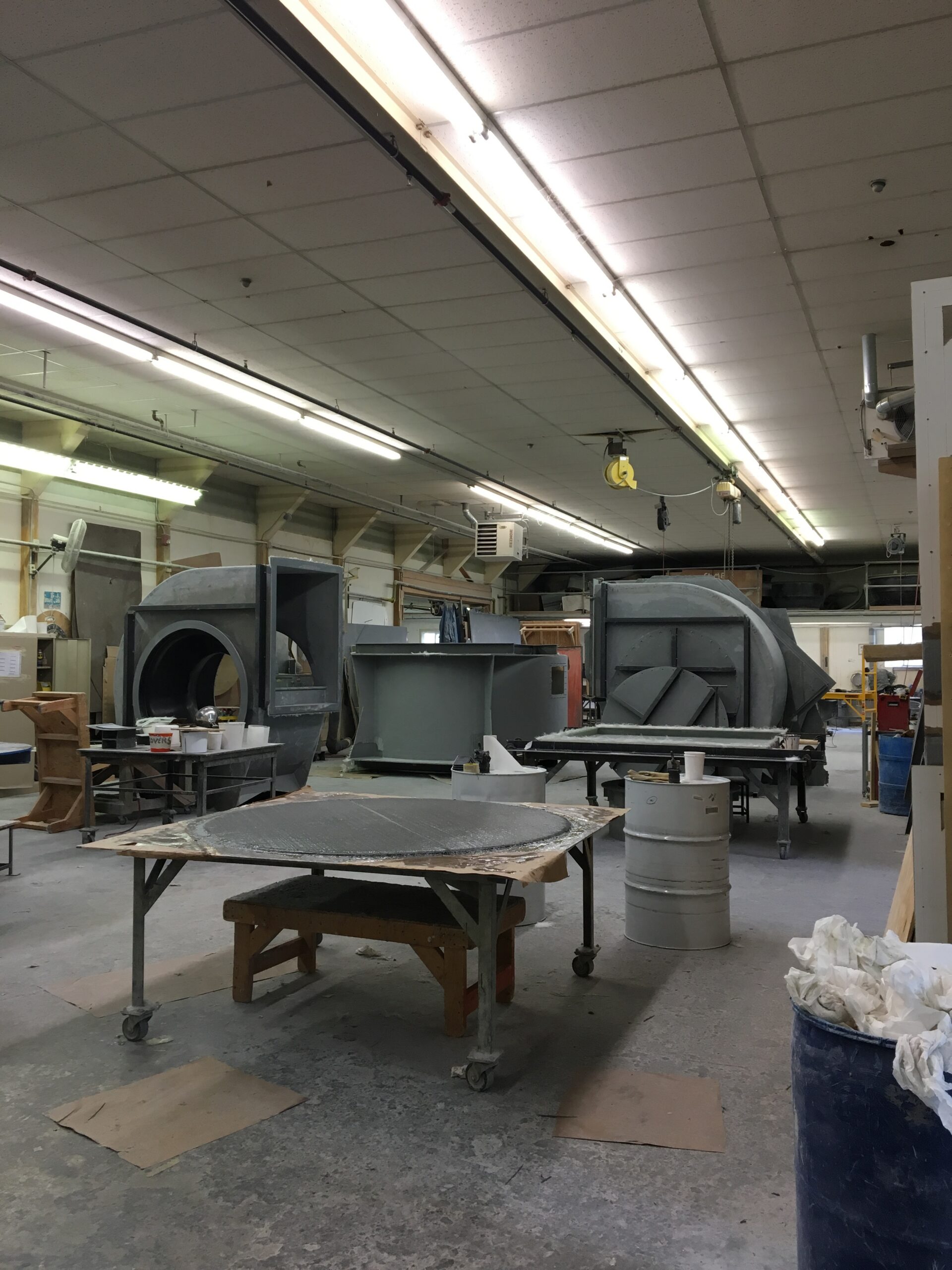
Standard fan configurations address the majority of industrial exhaust applications but process conditions, space constraints, duct configurations and application-specific requirements frequently require custom-engineered solutions. Custom fans are engineered from standard centrifugal and axial fan designs modified to specific application requirements, such as construction materials, arrangements, discharge positions, speed, mounting configuration and accessories. When off-the-shelf solutions cannot meet the operational requirements of the application CECO custom engineers solutions.


CECO Environmental designs and manufactures corrosion-resistant industrial exhaust fans and air handling systems for chemical, pharmaceutical, semiconductor, municipal wastewater treatment, metal finishing and industrial process exhaust applications. Solutions are provided as both standard and custom-engineered systems with materials of construction including fiberglass reinforced plastic (FRP), carbon fiber composite and specialty resin systems selected for the specific chemical environment of each application. CECO offers turnkey project delivery including fan selection and engineering, fabrication, installation, startup and field service and rebuild support.


More Than Equipment. Engineered for Industrial Air Excellence.
As the world’s most complete end-to-end industrial air quality platform, CECO Environmental spans every stage of the industrial air treatment process, from the point of generation through final compliance. We listen and solve, innovate and support, across every major global market, so nothing stands in the way of your operations.
